
Epistεme Core
Real World Applications of
Euler-Mehta Financial Spacetime
and
Aesthetic Epistemology
The Geometry of Investor Irrationality:
Euler-Mehta Financial Spacetime
and the Advantage of Patient Capital
A geometric framework unifying price dynamics, behavioral psychology, portfolio construction, retirement income, and sovereign wealth institutional design.
The advisory infrastructure for institutional implementation exists through global asset managers' official institutional groups (OIGs), sovereign wealth fund consultancies,
and pension governance platforms.

Aesthetic Epistεmology
Aesthetic Epistemology is a contemporary transformation of classical philosophical principles regarding knowledge.
In a world where geometric structure underlies the dynamics of financial markets, human cognition, and institutional design, the ancient question of how we know what we know becomes operational.
The five virtues of thought that Aristotle distinguished, epistēmē, téchnē, phrónēsis, sophía, and aesthetics, converge in the Euler-Mehta Framework as the philosophical foundation from which the mathematics, the methodology, and the institutional architecture all emerge.
A Guided Tour of Aesthetic Epistemology
Aesthetic Epistemology describes a form of knowledge production where structure is made visible
that was hidden from the observer.
The loss-recovery asymmetry was always hyperbolic.
Multiplicative structures were present in the data for decades.
What was missing was the geometry to see them.
Aesthetic Epistemology is the conviction that when knowledge is structured with precision and expressed with clarity, what was hidden becomes not only visible but beautiful.
The five virtues that follow are its philosophical foundation.
the philosophy of knowledge
epistēmē

Aristotle
He distinguished between five virtues of thought: technê, epistēmē, phrónēsis,
sophía, and nous (mind),
with epistēmē translating as "knowledge."In philosophy, epistēmē is a term that refers to a principle system of understanding,
such as scientific knowledge
or practical knowledge.The term epistemology (the branch of philosophy concerning knowledge)
is derived from epistēmē.Epistemology is considered a major subfield of philosophy, along with other the major subfields
such as ethics, logic, and metaphysics.A full account of epistēmē is given in
Posterior Analytics, where Aristotle
argues that knowledge of necessary truths,
rather than contingent truths,
regarding causation is
foundational for epistēmē.
the philosophy of practical knowledge
téchnē

Plato
In philosophy, téchnē is a term that refers
to making or doing. As an activity,
téchnē is concrete, variable,
and context-dependent.
The relation between epistēmē and téchnē in
classical philosophy offers an interesting contrast with our own notions about
theory (pure knowledge)
and (experience-based) practice.The Greek word téchnē, usually translated as "art," but also as "craft," "skill," "expertise,"
"technical knowledge," and even "science,"
has been decisive in shaping
our shared technological culture.David Roochnik, in his Of Art and Wisdom:
Plato's Understanding of Téchnē (1998),
writes that Plato views téchnē as
"a stable body of reliable knowledge able to tell us
in fixed terms readily teachable to others,
how we ought to live."
the philosophy of practical wisdom
phrónēsis

Socrates
In philosophy, phrónēsis is a term that means prudence, practical virtue
and practical wisdom; colloquially,
sense (as in "good sense", "horse sense").
It is an ancient Greek word for a type of wisdom or intelligence relevant to practical action.
Phrónēsis signifies both good judgment
and excellence of character & habits.Plato writes in his dialogues, that Socrates proposes that phrónēsis is a necessary condition for all virtue.
Being good, is to be an intelligent or reasonable person
with intelligent and reasonable thoughts.Phrónēsis allows for a person
to have moral or ethical strength.Phrónēsis is the groundwork of your business culture, ethics, and values for the good of humanity.
the philosophy of the art of life
sophía

Seneca
In philosophy, sophía is the
ancient greek word for wisdom.The Stoic philosopher Seneca wrote
a series of 124 letters at the end of his life.
The letters often begin with an observation on daily life,
and then proceed to an issue or principle
abstracted from that observation.The result is like a diary, or handbook
of philosophical meditations and sophía.Sophía is the ability to discern the difference
between what is good, what isn’t good,
and what is neither.This is an essential tool as it allows
you to act deliberately.Otherwise, how can you know what the highest good is and how to achieve it?
“If one does not know to which port one is sailing,
no wind is favorable.” – Seneca
the philosophy of beauty
aesthetics

Immanuel Kant
Aesthetics is a branch of philosophy that deals with the nature of beauty and taste.In aesthetics, the sublime is the quality of greatness, whether physical, moral, intellectual, metaphysical, spiritual, or artistic.The classical notion of the sublime was conceived by Immanuel Kant in his work Observations on the Feeling of the Beautiful and Sublime (1764).The term especially refers to a greatness beyond all possibility of calculation, measurement, or imitation.Applied aesthetics is the application to cultural constructs. In a variety of fields, artifacts (whether physical or abstract) are created that have both practical functionality and aesthetic affectation.In some cases, aesthetics is primary, and in others, functionality is primary. At best, the two needs are synergistic, in which "beauty" makes an artifact work better, or in which more functional artifacts are appreciated as aesthetically pleasing.This achievement of form and function, of art and science, of beauty and usefulness, is the primary goal of design, in all of its domains.
Aesthetic Epistemology
seamlessly illuminates and weaves together an
episteme core
utilizing the following five principles:
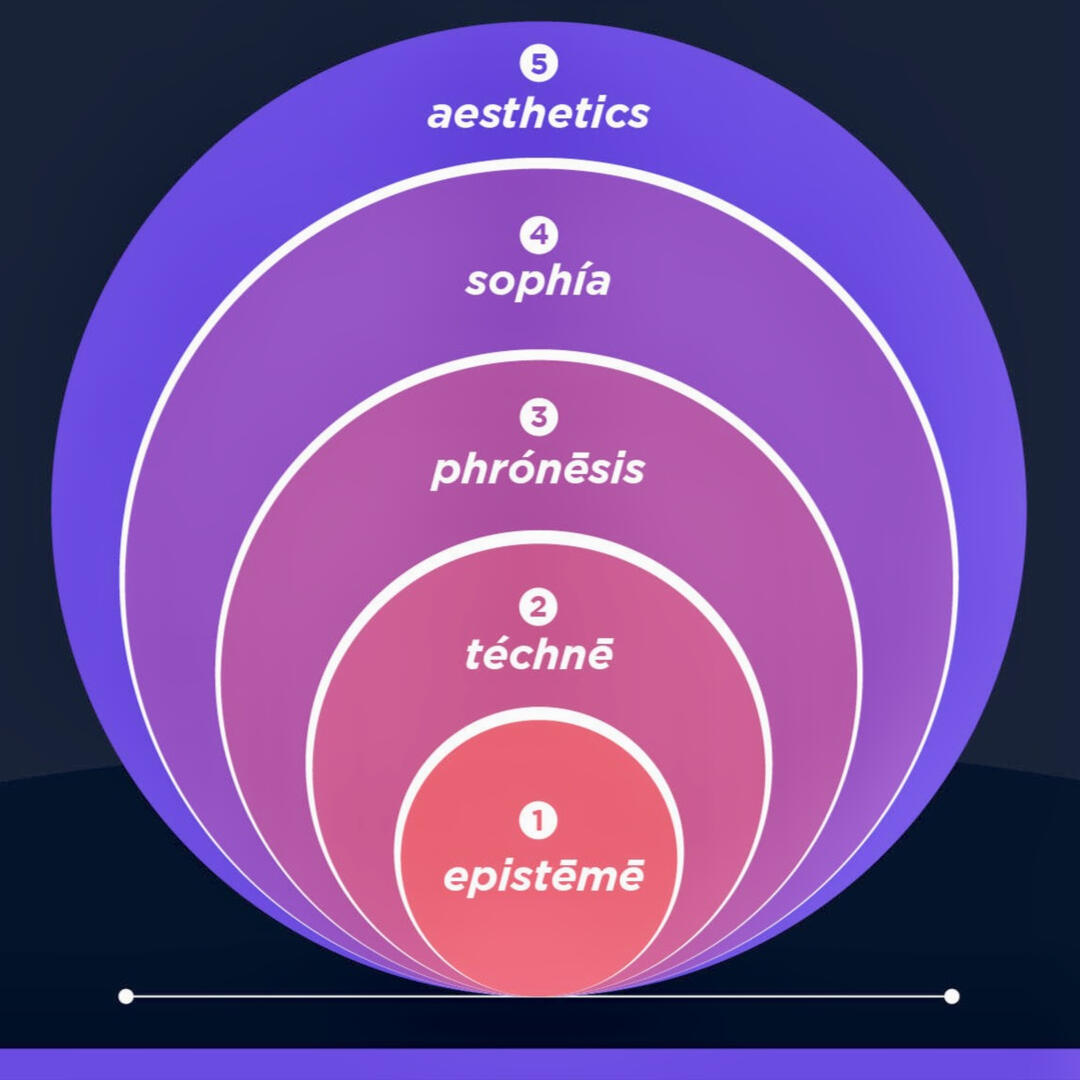
aesthetics:
achievement of form and function, of art and science, of beauty and usefulness
{the philosophy of beauty}
sophía:
the wisdom to discern the difference between what is good, what isn’t good, and what is neither
{the philosophy of the art of life}
phrónēsis:
practical sense
{the philosophy of practical wisdom}
téchnē:
scientific or technical skill
{the philosophy of practical knowledge}
epistēmē:
Knowledge of necessary truths
hidden within multiplicative dynamics.
{the philosophy of knowledge}

Euler-Mehta
Financial Spacetime
Euler-Mehta Financial Spacetime is a Riemannian manifold with constant Gaussian curvature K = -1, constructed from the observation that a 50% decline in price requires a 100% gain to recover. From this arithmetic fact, pursued to its geometric conclusion, an entire framework emerges.
The framework rests on four pillars. Price Dynamics (I) derives the Euler-Mehta Ladder from geodesic optimization on the manifold. Portfolio Dynamics (II) extends the geometry to multi-asset portfolios through the product manifold. Competitive Dynamics (III) derives threshold market capitalizations at powers of e and prescribes an optimal position count of N* approximately 15. Behavioral Dynamics (IV) links the deployment parameter to three independently measured cognitive biases whose product
converges to e2 with 0.27% precision.
From a single surface and a single constant, the EM Framework produces a deployment rule, a portfolio, a safe withdrawal rate, and a sovereign institutional architecture.
The mathematics and main paper are available on Zenodo.org


The Geometry of
Investor Irrationality
The Geometry of Investor Irrationality main paper
proposes that investor irrationality is not a failure mode to be corrected but a geometric property to be harvested. The behavioral premium, approximately e2 per year, is generated by human cognitive architecture interacting with multiplicative dynamics on a hyperbolic manifold. It is inexhaustible, non-extractive, and available to any institution with the patience and governance to harvest it.
The paper derives a geometric EM Safe Withdrawal Rate of 3.57%, achieving 100% portfolio survival across all historical cohorts.The Inverse Euler-Mehta Ladder transforms sequence-of-returns risk from a portfolio survival problem into an income variability problem, eliminating the failure mode that has defined retirement income research for three decades.It derives a sovereign wealth fund architecture, the EM Per Capita Equation, governed entirely by Euler's number. And it demonstrates that the behavioral premium can fund citizen dividends without eroding the sovereign corpus.
The paper and its companion appendices are offered as a contribution to human flourishing, not as a proprietary claim. The author welcomes collaboration with institutions, sovereigns, and researchers who share the vision articulated in this work.The framework's sovereign architecture is designed for implementation at any GDP scale, with contribution rates averaging 1.8% of GDP annually, and has been validated across three nations spanning the full range of economic development.
Dr. Sandip Mehta is a practicing internal medicine physician, a Fellow of the American College of Osteopathic Internists, and a second-year MBA student in the Alliance for Physician Leadership program at the Naveen Jindal School of Management,
University of Texas at Dallas.
He holds a B.A. in Astronomy from the University of Texas at Austin.
The Geometry of Investor Irrationality is his first academic paper. It was developed over twenty years of independent thinking about the intersection of compound growth, human cognition, and institutional design, and written with the assistance of Claude AI.
About

Epistemology, at its core,
is the philosophy of knowledge.
Philosophy means "love of wisdom" and is the systematized study of general and fundamental questions, such as those concerning
knowledge, reason, and mind.Epistemologies shape things in the realm of knowledge
in finance, institutional design, and life.Personal and institutional epistemology dictates how you see the World, analyze problems, and conceive solutions.You see what your knowledge tells you that you are seeing.
And when your knowledge changes,
the World changes for you.This episteme core is true for individuals, families,
communities, institutions, sovereign funds, and nations.Regard epistemology as a prodigious superpower:
the dynamism of data, ideas,
imagination, and knowledge.Expressing and identifying an Episteme Core
attains knowledge and wisdom illuminated:
from observation to structure to geometry,
to profound institutional design.Episteme Core applies the epistemology of
Euler-Mehta Financial Spacetime to reconcile
opposing forces and unify contrasting ideas
in both aesthetic and innovative ways.The Euler-Mehta Framework demonstrates that what appears as disorder in financial markets is, when viewed through the correct geometry, a harvestable structure. The same principle applies to institutional design: what appears as resistance is, when viewed through the correct architecture, a convertible resource.Discover how Episteme Core can help formulate antifragile institutional architecture through the
geometric framework described in
The Geometry of Investor Irrationality.It is inexhaustible, non-extractive, and available to any institution with the patience and governance to harvest it
Get in touch today
Contact

Dr. Sandip Mehta
Founder
D.O., FACOI
B.A. in Astronomy
MBA Candidate (Y2)
Author of
The Geometry of Investor Irrationality:
Euler-Mehta Financial Spacetime
and the Advantage of Patient Capital